
Devotionals
6 Sins Parents Commit Against Their Children Without Realizing It

 It is not only children who can sin against their parents; parents can also sin against their children. In our efforts to provide good and healthy parenting for our children, we often make a number of mistakes without realizing it.
If done repeatedly, these sins can damage a child's emotional health, make them unhappy, and even hinder the development of their best potential. The term for this kind of parent is toxic parents, or “poisonous parents.”
These are the sins that make parents “poisonous” to their children:
Sin 1: Refusing to Grow

Even though there are already many parenting courses on various platforms, there is still no educational diploma that can declare that we have graduated as parents. Even so, this is no excuse for us to be lazy about learning. As children grow older, it is only right that our parenting should also develop.
Sadly, what often happens is that parents complain that raising children is no longer as easy as it used to be, then accuse their children of being hard to manage. Not knowing the right parenting approach causes parents to raise their children based only on what they know. In fact, their children have grown, so the way they parent must grow as well.
So then, where can we gain parenting? Personally, I have learned the most from the church community, which I then complemented with outside sources such as books. Take advantage of easy access to information and the variety of learning platforms as a means to keep growing as a parent.
A lazy man does not roast his game, but the diligent obtain precious wealth. – Proverbs 12:27
Train up a child in the way he should go, and even when he is old he will not depart from it. – Proverbs 22:6
Sin 2: Comparing Children

Every child has his or her own uniqueness. Sadly, quite a few parents like to compare a child with a sibling or someone else's child. In fact, comparing children indirectly teaches them to compete. Not only does this discourage a child, it can also grow hatred in the child's heart toward the one being used as the comparison.
Accept your child's uniqueness as it is. There are four-year-old children who can already read fluently; there are also those who cannot yet, but they are good at math. Do not look at your child's strengths and weaknesses with a judgmental heart. If a child needs to grow in a certain area, help with love, not by shaming them or using another child as the standard.
Let no corrupt word come out of your mouth, but only what is good for building up, as fits the need, so that it may give grace to those who hear. – Ephesians 4:29
Sin 3: Ignoring a Child's Opinion

Another mistake parents make is thinking that their opinion is the most important, so the child must listen to them, but they do not need to listen to the child. They dismiss the child's opinion with the excuse, “That is not important.”
No matter how young a child is, parents must still value them, because this teaches a child how to communicate well. If their opinion is often ignored, it is very possible that the child will grow up to be someone who is less confident, unable to express feelings, or finds it difficult to make friends with many people.
And you, fathers, do not provoke your children to anger, but bring them up in the training and instruction of the Lord. – Ephesians 6:4
My beloved brothers and sisters, remember this: everyone should be quick to listen, slow to speak, and also slow to become angry. – James 1:19
Sin 4: Making Negative Statements

Many people believe that a parent's words are a prayer over a child. Whether that is true or not, one thing is certain: a parent's words have a great influence on a child's mental development. Why? Because parents are the closest people a child trusts most.
One example of this sin is calling a child naughty, stupid, or crybaby. A parent's negative statements will enter the child's subconscious, and if repeated over and over, will make the child think they are true. As a result, the child actually begins to act like what the parents have said.
Children tend to learn from what they see and hear. Does our child behave the way we accuse them of being? If that is what is happening, then it is good for us as parents to examine ourselves: are there any negative words that we often speak to our children without realizing it?
Fathers, do not embitter your children, lest they become discouraged. – Colossians 3:21
Sin 5: Taking Out Anger on Children
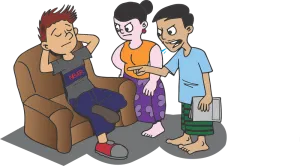
Generally, this happens when parents argue, and then the child becomes the target of their anger. I myself have not escaped this mistake.
On one occasion, I was involved in a heated argument with my wife. Because I was upset, I brought up our children's mistakes, then scolded them in front of my wife. My purpose in doing that was to hurt my wife's feelings, and our children, who knew nothing about it, became the victims of my emotional outburst.
Taking out anger on children is a dangerous act. Do not make our children victims of conflict with a spouse. If this continues, a child can grow up with a victim mentality (victim mentality).
A child with victim mentality tends to think negatively, feel that they are always the victim of other people's mistakes, or that whatever they do is always wrong. The result is that the child always lives in worry, often blames others, or avoids responsibility.
And you, fathers, do not provoke your children to anger, but bring them up in the training and instruction of the Lord. – Ephesians 6:4
Sin 6: Loving with Conditions

Perhaps we have said to a child, “You have to be a good child if you want to be loved.” In fact, it is already a parent's duty to love their child no matter what.
Love the child who behaves well, and love also the child who behaves badly, namely by disciplining and treating them fairly. Does not God still love us, even though we have committed many wrongs against Him?
But if anyone does not provide for his relatives, and especially for his own household, he has denied the faith and is worse than an unbeliever. – 1 Timothy 5:8
“Whatever you wish that others would do to you, do also to them. This is the sum of the Law and the Prophets.” – Matthew 7:12
“Honor your father and mother, and love your neighbor as yourself.” – Matthew 19:19
Learning to be a parent is a lifelong process. We can learn from people who are experts in this field, and also from a healthy community. Avoid the sins that make us “poison” to our children, and if we have already done them, let us quickly leave them behind. Let us give our best to our children, because that is indeed our duty as parents. Amen. - Related Articles:
- Guard Your Tongue from These 4 Things
- How Should We Respond to a Child Who Likes to Lie?
- Do Not Be Quick to Judge
- Children: A Hindrance or an Encouragement in Serving God?
- Tips for Facing the Challenges of Single Parents
About the Author

Digital Ministry Team
The Digital Ministry Team is the digital ministry of GKDI (Gereja Kristus di Indonesia), bringing the good news of the gospel into digital spaces — through articles, videos, and content anyone can reach, anytime.
We write about faith, family, work, and everyday struggles — the real things people wrestle with, seen through an honest and down-to-earth biblical lens. Our hope is simple: that every article helps you know Jesus more closely and grow together with a community.
Have a question, some feedback, or a story to share? Reach us through GKDI social media or at [email protected].
God's House, Our Home.
RELATED ARTICLES

New Life, New Beginning
Everything new is usually appealing, including a new life. That is, when we leave the old behind and step into an experience that is truly new. Speaking of a new life, there is…
Read More
Christmas Day, Time to Reflect on These 3 Things
When I was little, Christmas Day was a special day. Besides receiving many gifts from Sunday school, I was also treated to many attractions such as dramas, Christmas songs...
Read More
3 Heart Attitudes from the Song Everlasting Father
For You are my Father, the everlasting Father. I am sure many of us are familiar with this song, Everlasting Father. Its lyrics lead us to reflect more deeply on God the Father and what He does in this life...
Read More